
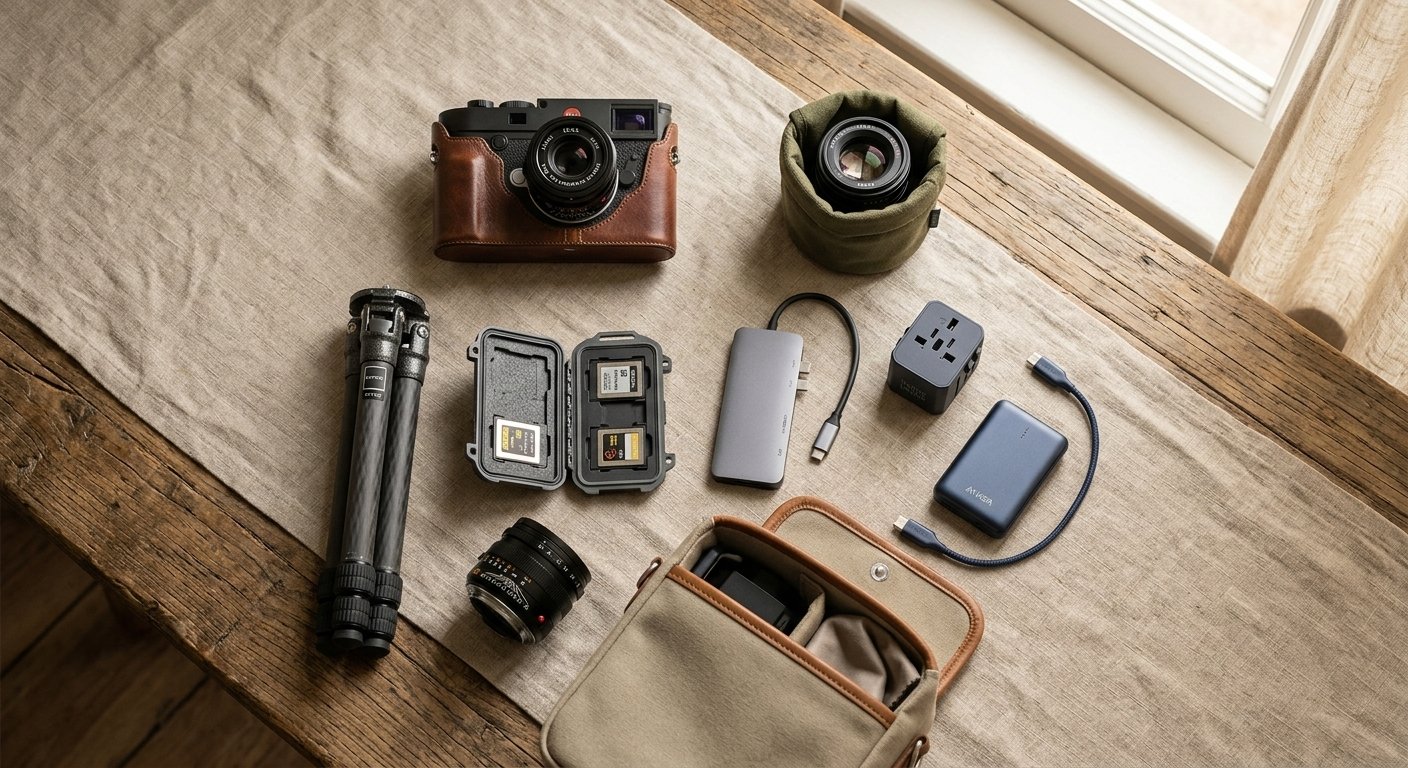
The dream of travel photography is often capturing stunning, authentic moments without being weighed down by a monstrous backpack. But how do you achieve professional results when you’re strictly committed to minimalist packing? The secret isn’t sacrificing quality; it’s about choosing highly versatile, multi-purpose gear.
Here is a curated list of eight compact, high-performance essentials designed to keep you agile on the move while ensuring you never miss the shot.
1. A Premium Mirrorless System
The days of bulky DSLRs being mandatory for travel are over. Today’s top mirrorless cameras, like the full-frame Sony A7C or the tactile Fujifilm X-T5, offer incredible image quality in a body that’s often half the size. They fit discrete, small bags and don’t scream “tourist.”
- Minimalist Tip: Opt for a body with internal weather sealing and a stabilizing sensor to reduce the need for heavy accessories.
2. One Versatile Prime Lens
The temptation to pack a “trinity” of zoom lenses is strong, but a single prime lens is the ultimate travel tool. A 35mm f/1.8 or f/2 lens (the quintessential street photography focal length) is compact, fast (great in low light), and remarkably versatile for everything from environmental portraits to landscapes.
- Minimalist Tip: Using a single prime forces you to “zoom with your feet,” resulting in more creative, dynamic compositions.
3. An Ultra-Portable Travel Tripod
Long exposures and sharp night shots require stability, but a heavy aluminum tripod is a burden. Minimalist photographers opt for lightweight carbon fiber models or high-quality tabletop tripods that can fit in a jacket pocket, like the Peak Design Travel Tripod or a versatile Gorillapod.
- Minimalist Tip: If you can’t fit a tripod, look for the ‘Alternate Support’ feature in your camera’s IBIS (in-body stabilization).
4. A Rugged, High-Capacity Power Bank
Your phone handles navigation and behind-the-scenes content, and many modern cameras can charge via USB-C. A fast-charging 10,000mAh to 20,000mAh power bank, like those from Anker or Goal Zero, is a non-negotiable safety net for long shooting days.
5. All-in-One Memory Card Case & Hub
The worst nightmare of any photographer is losing footage. Skip the individual card cases and invest in a single, weatherproof, drop-resistant case. Combine this with a lightweight USB-C media hub that accepts SD and microSD cards to easily transfer photos to your mobile device or laptop for editing and backing up.
6. Circular Polarizer and Variable ND Filters
These are the only physical filters most travel photographers need. A circular polarizer (CPL) cuts glare on water and boosts contrast in bright skies, while a Variable ND allows you to shoot wide open (achieving shallow depth of field) or take long exposures in broad daylight.
- Minimalist Tip: Choose filters in your largest lens thread size (e.g., 67mm or 77mm) and use inexpensive ‘step-up rings’ to adapt them to your smaller lenses.
7. An Unobtrusive, Stealthy Camera Bag Insert
Instead of a dedicated camera backpack that looks bulky and targets you as carrying expensive gear, use a modular ‘camera cube’ or padded insert. Place this inside an anonymous-looking daypack, messenger, or even your existing travel bag.
- Minimalist Tip: Use an insert that just fits your camera body and two lenses. Anything extra will encourage overpacking.
8. The Master Key: A Universal Travel Adapter
Minimalism also applies to accessories. Forget packing multiple charging blocks. A single, high-quality, all-in-one international adapter that covers US, UK, EU, and AU plugs—especially one with multiple integrated fast USB-A and USB-C ports—is all you need to keep your toolkit powered globally.
Conclusion
Travel photography minimalism isn’t about restriction; it’s about liberation. By refining your toolkit to these eight essential items, you free yourself to move faster, blend in with locals, and focus entirely on the authentic experience happening in front of your lens. This agile setup ensures your trip is defined by discovery, not logistics.